
No, I’m Not “Just in Marketing.” But Also… Kind of? Let Me Explain.
It often happens. You’re at a braai, or you meet someone new, and they ask what you do for a living. You say “marketing.” They nod. You can see it in their eyes, they’ve already moved on and are thinking about the next question or the potato salad.
But then comes the follow-up.
“So you do social media?”
And there it is. That moment where you have two options: launch into a full explanation that kills the vibe, or smile and say “something like that” and reach for the nearest snack.
I’ve been choosing the snack for ten years. But not today.
Because I’ve worked across PR, communications, brand management, content, and what most people just lazily lump together as “marketing”. I think it’s finally time someone broke it down properly. No jargon. No textbook. Just the honest, slightly dramatic truth about what these disciplines actually are, how they’re different, and why it matters.
First, a confession.
I studied Corporate Communication. I have a BA Honours degree and everything. But when people ask what I studied, I say “Marketing.” Why? Because it’s easier. Because “Corporate Communication” makes people tilt their heads like a confused Labrador. And because honestly, at a surface level, it all leads to the same place: getting people to pay attention to something, and hopefully feel something about it.
So here’s the honest breakdown.
Marketing: The Parent. The Boss. The Umbrella.
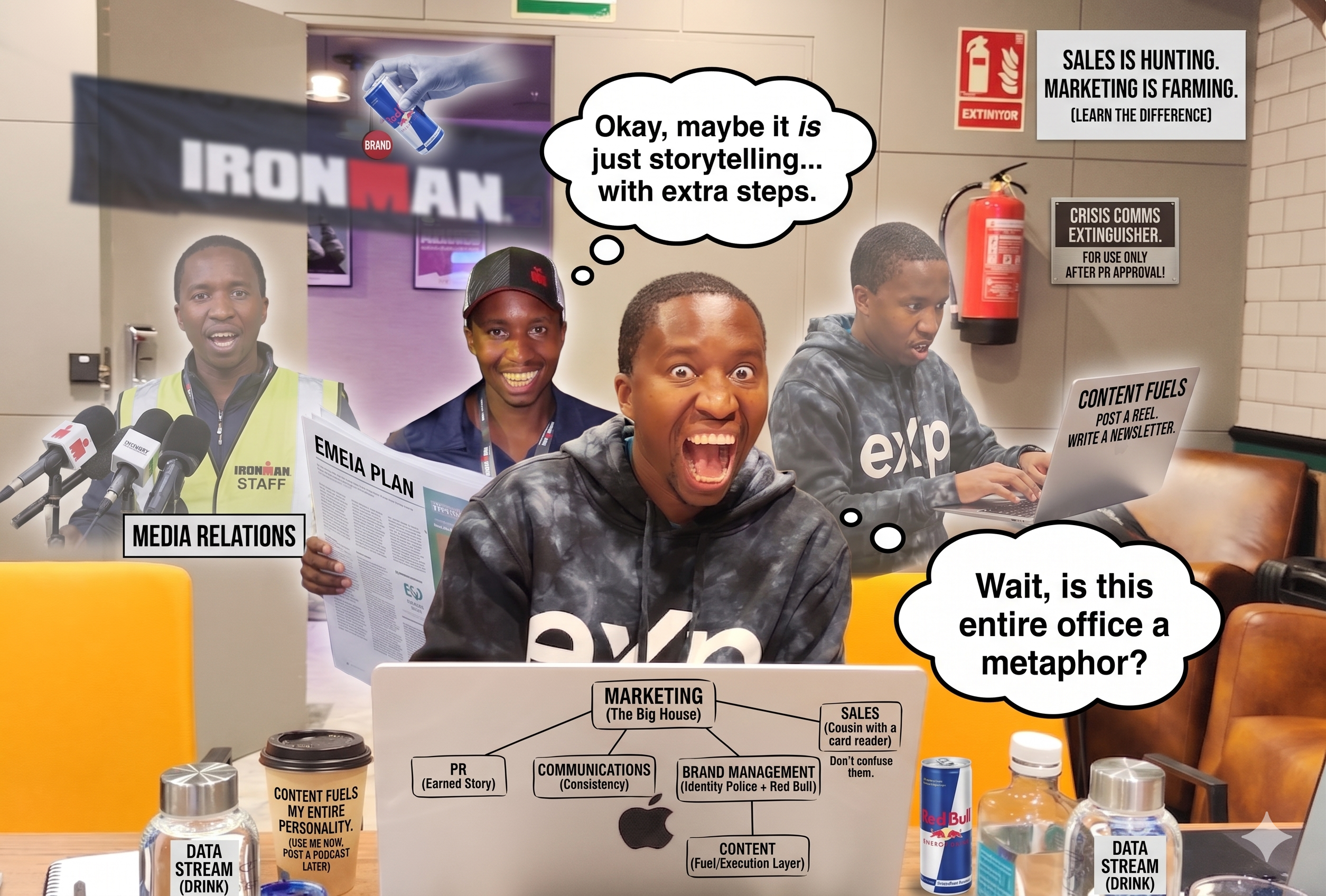
Think of marketing as the big house. Everything else lives inside it.
At its most basic, marketing is the process of identifying what people want or need, and positioning a product or service to meet that need. It’s making the company profitable. It’s strategic. It’s data-driven. It’s about understanding your audience, building a plan, allocating budget, and driving measurable outcomes.
When I’m at work as the Marketing Manager for EMEIA at eXp Realty (that’s Europe, Middle East, India and Africa, yes it’s a mouthful), my job is fundamentally a marketing job. I think about how to grow brand awareness and agent acquisition across multiple markets with very different personalities. I think about campaigns. Channels. ROI. How do we reach people in France differently to how we reach them in Dubai? What does a real estate brand mean to someone in the UK versus someone in South Africa?
That’s marketing. It’s the strategy layer. It’s asking: who are we talking to, what do we want them to think, feel, or do, and how do we make that happen?
It is NOT the same as sales.
Sales: Marketing’s Cousin Who Actually Asks for the Money
Here’s the thing about sales, it picks up where marketing leaves off.
Marketing warms the room. Sales closes the deal.
Marketing says: “Here’s why this product is awesome and why you need it in your life.” Sales says: “Great, shall I take your card details?”
One is about building desire and preference at scale. The other is about converting an individual human being in a specific moment. Both are critical. But they are not the same job, they don’t require the same skills, and please stop putting them in the same department and wondering why both suffer.
The classic analogy: if marketing is farming (planting seeds, nurturing, waiting for the harvest), then sales is hunting (identifying the target, moving in, closing). Both feed the village. Very different energy.
I have never been in sales. I am in marketing. Moving on.
Public Relations: The Art of Not Paying for Attention (But Still Earning It)
PR is where I started. And it’s where I learned that the most powerful coverage money can’t buy, which is exactly the point.
Public Relations is about managing the relationship between a brand (or person, or organisation) and the public, primarily through media. A PR person isn’t writing ads. They’re writing press releases, pitching journalists, managing media relationships, handling crises before they become headlines, and building narratives that a brand doesn’t pay to place.
When I was at The IRONMAN Group as Regional PR & Communications Specialist for EMEIA, I was talking to journalists across Europe, the Middle East, and Africa. I was crafting stories about athletes, race events, and brand partnerships. I was making sure that when someone at a newspaper or sports channel in Germany or South Africa covered an IRONMAN event, the story was accurate, compelling, and reflected well on the brand.
The key thing about PR? It’s earned media. Not paid. When a journalist writes about you because your story is genuinely interesting, that carries more credibility than any ad. You can’t buy that. You can only earn it.
Oh, and crisis comms falls here too. When something goes wrong, and in events management, things absolutely go wrong, PR is the person in the room saying “here’s what we say, here’s what we don’t say, and here’s when we say it.”
It’s the discipline that taught me: the best PR isn’t reactive. It’s relentlessly intentional. You build the relationships before you need them.
Communications: PR’s Quieter, More Internal Sibling
People often use PR and Communications interchangeably. They’re related, but not identical.
PR, as we covered, is largely external. It’s about your relationship with the media and the public.
Communications is broader. It includes internal communications (talking to your own people: staff, agents, partners), external communications (media, stakeholders, the public), and crisis communications (when the wheels come off, publicly or privately).
In my roles, particularly at eXp Realty where we’re dealing with thousands of independent agents across multiple countries, communications became incredibly important. How do you ensure that a brand message or policy change lands consistently in Romania AND in India AND in the UK? How do you write for a global audience without losing the local nuance?
That’s a communications challenge. It’s not a PR challenge. It’s not a marketing challenge. It’s its own discipline with its own craft.
If PR is about telling your story to the world, communications is about making sure everyone (inside and outside your organisation) is hearing the same story.
Brand Management: The Identity Police (In the Best Way)
This is the one that trips people up the most.
Brand management is not about making things look pretty. (Though aesthetics are part of it.) It’s about protecting, building, and evolving what a brand means. Its identity, its personality, its promise, its reputation over time.
Think about it this way: Red Bull doesn’t just sell energy drinks. Red Bull sells the feeling that you’re the kind of person who does extraordinary things. That positioning, that meaning, doesn’t happen by accident. It’s fiercely managed. Everywhere Red Bull shows up, it feels like Red Bull. The design. The events. The partnerships. The language. The athletes they sponsor.
I had the privilege of working with Red Bull as a partner brand during my IRONMAN years. The way they show up at events is immaculate. Brand management at its finest.
In my current role overseeing EMEIA marketing at eXp Realty, a MASSIVE part of what I do is brand management across the region. Ensuring that even as individual markets localise their approach, the global brand remains consistent. That the logo isn’t being stretched, the messaging isn’t going rogue, and that we’re all telling the same essential story about who eXp Realty is.
Brand management sits at the intersection of strategy, creativity, and stubbornness. You have to be willing to say “no, that’s not on brand” even when it’s inconvenient.
Content: The Fuel That Powers Everything Else
You could argue that content isn’t a separate discipline so much as the execution layer across all of the above. But in the modern marketing world, it’s become its own thing.
Content is the stuff. The articles. The videos. The social posts. The podcasts. The email newsletters. The campaigns. The storytelling in all its forms.
A brand strategist tells you what to say and to whom. A content creator or strategist figures out how to say it and where.
I’ve lived in this space too. At Good News Lab, my first job, I was building social media strategies and creating content for brands. It taught me that great content isn’t about frequency. It’s about relevance. One piece of content that resonates is worth a thousand posts that don’t.
So What’s the Same? What’s Different?
Well this is how AI breaks it down (shoutout to Claude, my new best friend):
They all serve the same ultimate goal: Build awareness, trust, and preference for a brand, product, or person.
Where they differ:
- Marketing = the strategy and the plan. What, who, why, how much, what does success look like?
- Sales = the conversion. The ask. The close.
- PR = the earned story. Media relationships, press, public narrative.
- Communications = the message management. Internal and external, consistent and clear.
- Brand Management = the identity. The promise. The long game.
- Content = the fuel. The actual words, images, and ideas that carry all of the above.

And What Do I Actually Do?
Honestly? All of it. Just not always at the same time, and not always with the same job title.
That’s the secret about this industry that nobody tells you when you’re studying it: the boundaries are blurry. A good marketing manager needs to understand PR. A great PR person needs to think like a brand manager. A content strategist who doesn’t understand the broader marketing funnel is just making noise.
And then there’s events, which is its own beast entirely, and one that has taken up a significant chapter of my career. Events are where every discipline collides at once and you have approximately zero room for error. Your brand management better be tight, because thousands of people are experiencing it live. Your communications better be clear, because athletes, sponsors, media, and staff are all waiting on information. Your PR better be proactive, because journalists are on site and the story is happening in real time. I’ve led live race broadcasts on SuperSport. I’ve managed sponsor activations for brands like Red Bull and Qatar Airways at global events. There is no “we’ll fix it in post” at a live IRONMAN event. It either works or it very publicly doesn’t.
Events taught me more about integrated marketing than any classroom ever could.
The job titles are real. The distinctions matter. But the best people in this industry are the ones who can move between them fluidly, because they understand what they’re all ultimately trying to do.
Tell a good story. To the right people. At the right time. In a way that makes them feel something.
That’s pretty much it. That’s the whole discipline. Ten years, three industries, multiple partnerships, global sporting events, EMEIA marketing strategies, and a CV that makes new acquaintances say “wait, what exactly do you do?”… and it all comes back to that.
So the next time someone asks me at a braai?
I might just say: “I tell stories for a living.”
Let’s see if that’s easier to explain.